We'll be back soon
Our website is currently undergoing maintenance. Thank you for your patience.
Simulation Software Limited
The batch management facility comprises three main functions:
The VariSim batch scheduling process provides a high level of control before the transfer of batches occurs. It allows you to pre-define the sequence of batches to be delivered in a schedule that clearly identifies the volume to be transported, its destination, customer details and its type. This process incorporates easy to use tools that allow quick definition of the schedule through drop down menus and sorting and sequencing algorithms.
Once the schedule is defined and submitted, the volumes of product entering the pipe can be monitored in accordance with the schedule with over-delivered and under-delivered volumes clearly identified to the operator. The batches are tracked in the physical sense by the VariSim simulator, and the progress of each batch can be accurately monitored as it progresses through the pipeline or network. Estimated times of arrival are continually provided for any defined locations on the pipeline or network. Virtual batch volumes and stripped batch volume can be monitored for efficient transfer of batches to the pipeline customers.
The batch predictive functions take the schedule and predict the future movements of batches through the pipeline using an offline VariSim simulator. The operator is able to specify pump statuses, tank starting conditions and variable supply / demand requirements that will continue to exist over the duration of the batching process in addition to the set-points of any control valves. Predictive simulations use the batch schedule as an input to the predictive process to determine the movement of the batches over the batching timeframe.
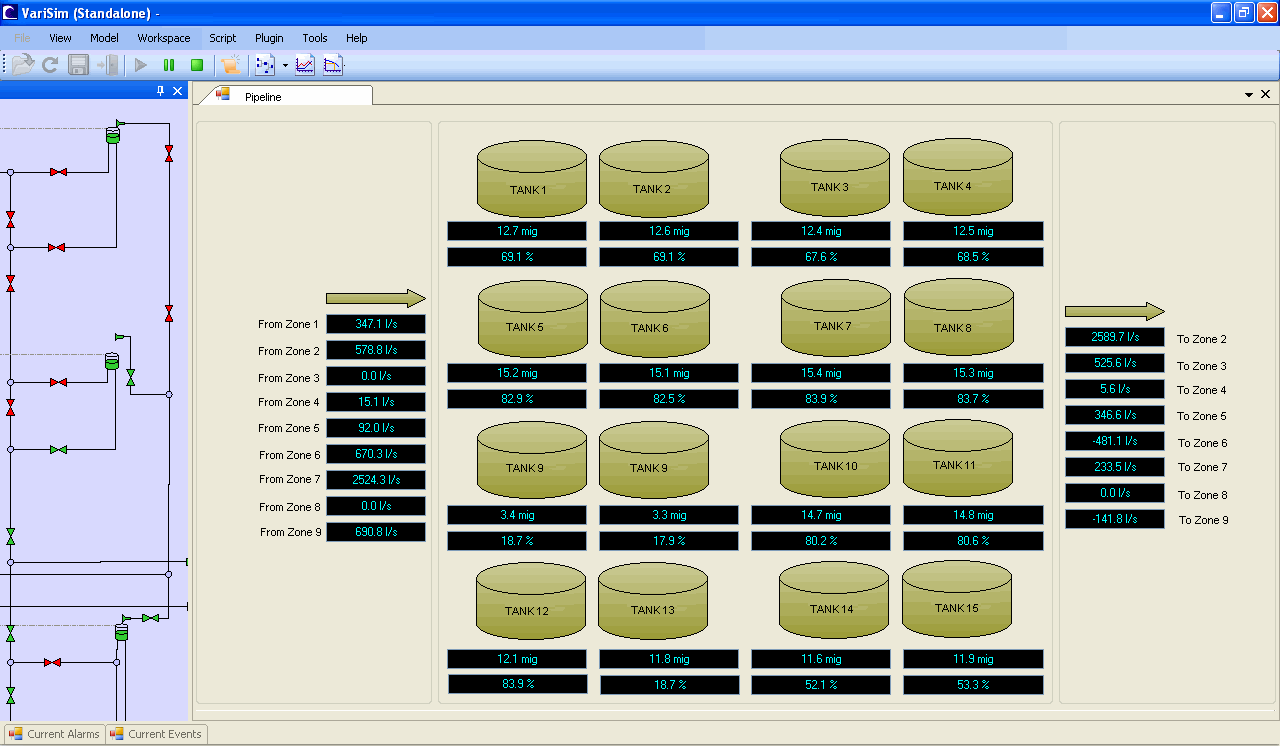
There are three levels to the standard Capacity / Storage Management process which can be easily expanded to include more complex management functions.
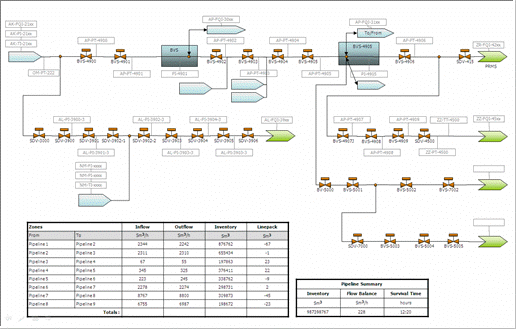
Current inventory distribution is available directly from the VariSim simulator which can be made available to an offline simulator. On a continual basis, the current inventory distribution is calculated on a pipe, zone or system basis and a survival time estimated using current inventory, rate of inventory increase and the maximum / minimum permissible inventory (often linked to maximum / minimum allowable operating pressures). Alarms will be raised for the user if inventories exceed or fall below allowable limits or if maximum / minimum allowable operating pressures are exceeded.
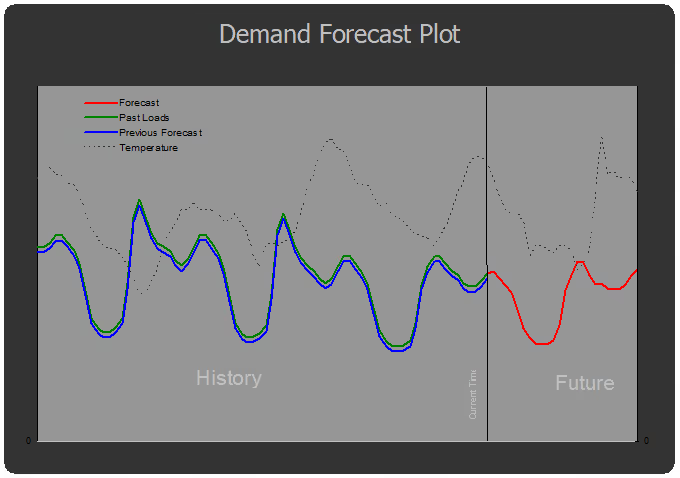
At each supply or customer demand, pre-defined future flow or pressure variations can be used to drive the simulator model. These variations may be nominations, they may be fixed values, they may be user input or they may be taken automatically from historical input or load forecasting tools.
Rapid simulations are then conducted to establish the future inventory distribution, future flow, pressure and temperature profiles (if required) and the predicted variation in the available capacity / storage levels.The actual storage variation can be monitored against the predicted storage variation. At any stage the user can change the future flow variations to predict the future actual and available capacity / storage variance to allow the inventories to be continually managed.

Our website is currently undergoing maintenance. Thank you for your patience.
Simulation Software Limited