We'll be back soon
Our website is currently undergoing maintenance. Thank you for your patience.
Simulation Software Limited
The VariSim Suite supports some very powerful applications for the oil and gas industry that can be applied to any pipeline configuration – whether simple A to B pipelines or more complex networks. Desktop studies can be undertaken for designing, planning, troubleshooting and optimising.
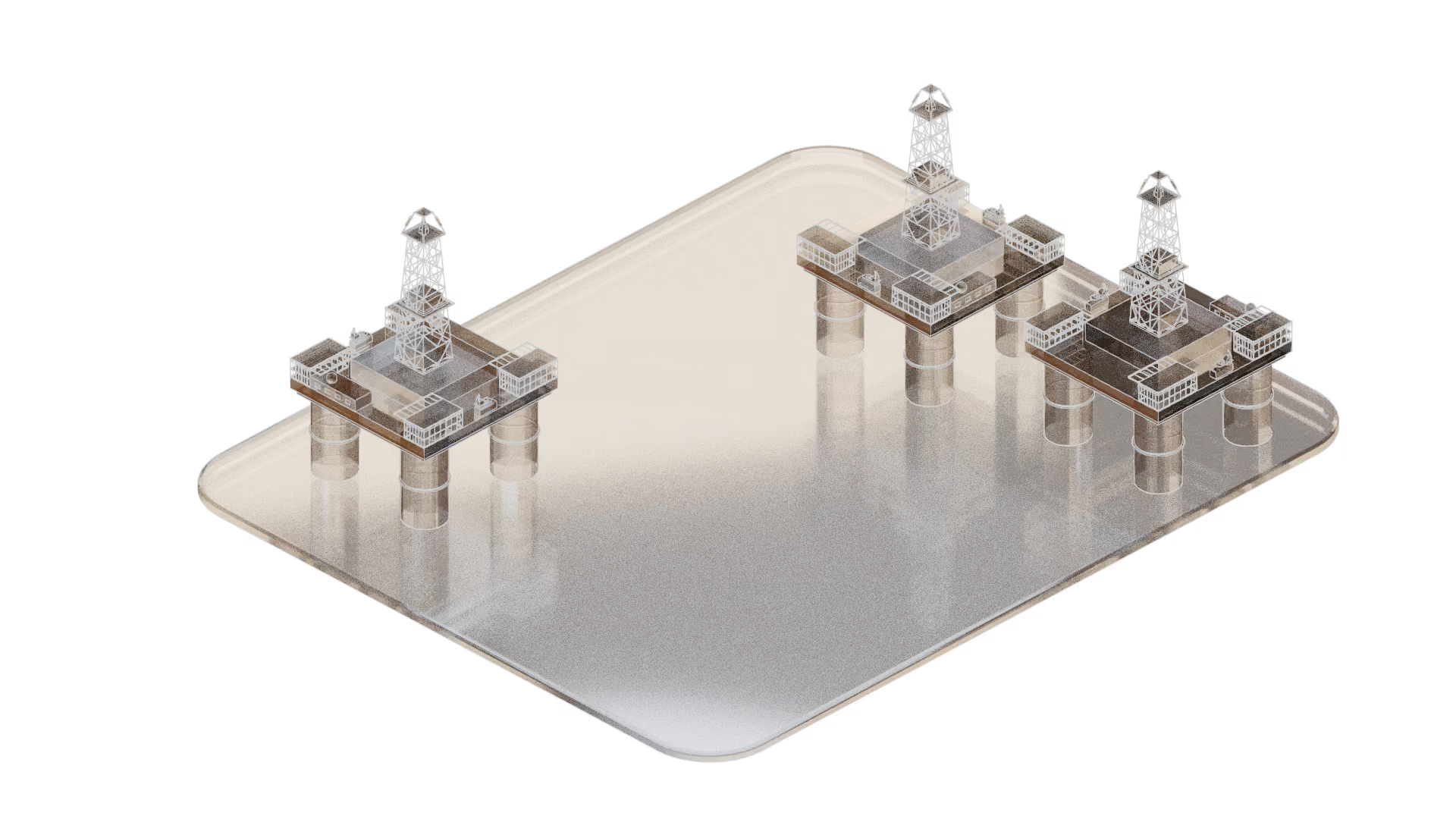
Use the powerful build processes to generate models of any oil/petrochemical pipeline or network including simple A to B pipelines, branched pipelines or complex networks. Simulator models are created with VariBuild using the inbuilt user interface with graphical drag and drop functionality and/or the model build wizard that imports models from third party databases or GIS shape files.
Functions:
Starting conditions can be based on design data, field observed data or logger data depending on the objective of the study which can include:-
Steady state flow, pressure and temperature distribution for detailed review.
Dynamic hydraulic and thermal reaction to equipment operation, control schemes and supply / consumer changes.The effects of surge suppression techniques
The distribution of Crude Oils and refined products (including batched) to identify quality, composition, source, age, interface mixing and any other component (such as DRA and its deterioration)
Perform repeated simulations to optimise the operation of the pipeline / network and accurately size equipment across the range of transient pipeline conditions. Example optimisations include pipe sizing, pump sizing, valve set-point and control system settings, surge vessels, DRA injection volumes, batch ordering etc.
Use the VariSim tools for tracing flow, analysing isolation sequences and their effects, inventory analysis, batch tracking, batch management and optimisation.
Display all VariSim output in a GIS format against any background shape files such as topographical layout.
VariSim has the ability to use measured data to drive it. With this type of simulation, it mimics the real pipeline and is often termed an online simulator or a digital twin. The measurement data may be logger data so that it mimics the pipeline / network reaction at the time the logger data was recorded, or it can use current data (obtained through the connection to a live database) to make the simulator a real time simulator.
A real time simulator can transfer its current state to a copy of the simulator operating in a desktop environment. This allows the user to initiate the simulation with current conditions for subsequent simulation and analysis.
In reality, all pipelines or networks are transient and frequently in a state of imbalance. True transient simulation is essential for solving the conditions of pipeline systems that are hydraulically imbalanced and a simulator that uses a steady state solution will frequently fail to achieve this.
Functions:
View any VariSim calculated value at any location on the pipeline / network including flow, pressure, temperature, velocity, density, wavespeed, DRA levels etc.
Obtain Virtual Instrumentation values at any location on the pipeline / system
Detect events and anomalies that develop on the pipeline / network.• High / Low Pressure, Flow, Velocity
• Excessive pressure loss identifying poor pipeline condition
• Over/under concentration of additives such as DRA
• Over / Under delivery of batches
• Low Quality Crude Mixing
Analyse the potential for customer interruptions
View all data against any GIS information including topographical layout, water sources (reservoirs, lakes and rivers) etc.
Add plugins for additional functionality including :-• Leak Detection and Location
• Inventory Management and Balancing
• Optimisation
• Pump Management
• Pig Tracking
• Pipeline Integrity and Efficiency
• Flash Point / Gas Breakout calculationsDisplay output in standard VariSim displays and / or a SCADA style graphical user interface.

Our website is currently undergoing maintenance. Thank you for your patience.
Simulation Software Limited